Jeffrey BeauregardVolusia County, Florida

Written from the other side of the desk

How car buying actually works

I sat on the other side of this desk for twenty years, running my own store. Almost nothing about the process is secret — it's just never explained. So here it is.


The short answerMost of it isn't negotiation

Why does it take so long?

Most of the wait has nothing to do with haggling. It's verification, documents, and the fact that your deal has to pass through several departments in order.

A vehicle purchase touches sales, management, the finance office, the title clerk and often the service department, and those steps mostly can't happen at the same time. Add a trade appraisal, a lender waiting on a document, and whoever came in ahead of you, and an afternoon disappears.

The wait itself isn't a tactic. Being left in the dark during it, however, is a choice — and it's the part I refuse to make you sit through without an explanation.
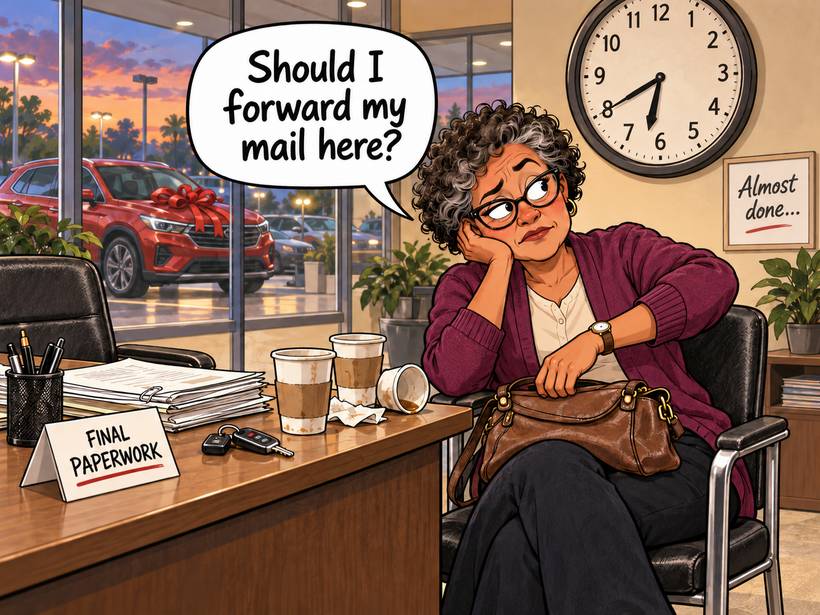
Cartoon of a customer waiting at a dealership desk beside a stack of final paperwork
The waiting roomFour hours is not unusual. Knowing why turns it from maddening into merely long.
The short answerPeople, in sequence

What's actually happening while you wait?

Your paperwork is moving between people, each of whom has to finish before the next can start.

Your information is being verified. Your trade is being inspected and appraised. If you're financing, an application is going out to lenders and coming back. Documents are being prepared, and in most states several of them have to be exactly right or the sale can't be registered. If the vehicle needs to be cleaned, fuelled or have accessories fitted, that's happening too.

You are entitled to ask where you are in that sequence at any point. Anyone who can't tell you either doesn't know or doesn't want to.

The short answerMarket judgment, not a formula

How is a trade value really decided?

A trade number is an estimate of what your vehicle brings at wholesale, minus what it needs, adjusted for how long it's likely to sit.

Someone inspects the vehicle, looks at what comparable ones are bringing at auction right now, subtracts reconditioning — tyres, brakes, cosmetic work, whatever it needs to be sold to someone else in good conscience — and forms a judgment. That's it. It isn't personal and it isn't arbitrary.

What it also isn't is a secret. If you ask what came off the number and why, that question has a real answer. I spent twenty years being the person who set those numbers, and I'll walk you through yours line by line if you want it.

The short answerSome, not all

What's negotiable, and what genuinely isn't?

Some things move. Some things truly don't. Anyone who tells you everything is negotiable is being agreeable rather than honest — and so is anyone who says nothing is.

Government fees and taxes are fixed. Manufacturer programmes have rules that a dealership does not get to bend. Optional products are optional and can be declined. Most of the rest sits somewhere in between, and where it sits depends on the vehicle, the timing, and how much room there is to begin with.

What I won't do is pretend that a limit is a favour, or that a fixed number is something I fought for on your behalf. You'll know which is which.

The short answerYou can say no to all of it

What does the finance office actually do?

It verifies your information, submits your application to lenders, prepares the legal documents, and presents optional products. You can decline every optional product and still buy the car.

The finance office exists because a vehicle sale is a regulated transaction with real legal paperwork behind it. That part isn't optional. The products presented there — service agreements, protection plans and the like — are, and some of them are genuinely worth having depending on how long you keep vehicles and how you drive.

My advice is simple: decide what you want before you're sitting in that office, and don't be talked past your own answer. If you want to think about something overnight, that is always allowed.

Bring theseWorth writing down

Questions worth asking before you sign

None of these are confrontational. They're just the questions that get you a clear picture, and a good salesperson will be glad you asked.

  • What is every line on this, in plain language?
  • Which of these items are optional, and what happens if I decline them?
  • What came off my trade number, and why?
  • Which parts of this figure are set by the state or the manufacturer?
  • What is covered, for how long, and by whom?
  • What would you do if this were your own family?

If any of those questions produce a vague answer, ask it again. Vagueness is information.

Plainly 

What I'd tell my own family

Decide what the vehicle needs to do for you before you fall in love with one. Go in knowing roughly what you're comfortable with and say it out loud. Take the time you need — nobody who deserves your business will punish you for thinking. And if something doesn't feel right, it is always, always fine to leave and come back.

That last one costs a dealership nothing and it's the single most useful thing I can tell you.